I always enjoy reading Caitlin Flanagan's articles in The Atlantic (and anywhere else I find them). I just read another of her wonderful Atlantic articles: What Girls Want. The article wraps a discussion of the Twilight books around a wonderful view into the lives and interior lives of adolescent girls. As the father of a two daughters (and a son), this article, like the others, is helpful, moving, and thought-provoking.
Thanks, Caitlin!

Over engineered vs Social engineered
Social engineering is when you use social techniques to achieve an engineering goal. It is a term mostly used in the technology commnuity to refer to ways to breach computer security systems. I call you up, sound officious (my British accent helps), and assure you I am calling to help you. There have been some suspicious activities on your credit card recently and would you mind reading the three digit security number off the back of the card to verify you still have it in your possession.
I have easily accomplished with social engineering something I could do with much more effort using a key logging program - a program similar to a computer virus that records what you type keystroke-by-keystroke, and sends me the results so I can pick out those magical three digits.
In my venture capital life we often hear about highly engineered, possibly over-engineered, technologies. Compared with other technologies they are clearly masterpieces. Compared with the ability of the human mind to be tricked (positively or negatively), they may not be worth the Powerpoint program they were conceived on.
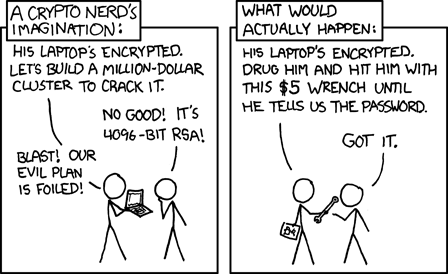
It is not even clear to me that these guys would need the drugs!
I have easily accomplished with social engineering something I could do with much more effort using a key logging program - a program similar to a computer virus that records what you type keystroke-by-keystroke, and sends me the results so I can pick out those magical three digits.
In my venture capital life we often hear about highly engineered, possibly over-engineered, technologies. Compared with other technologies they are clearly masterpieces. Compared with the ability of the human mind to be tricked (positively or negatively), they may not be worth the Powerpoint program they were conceived on.
It is not even clear to me that these guys would need the drugs!
Happiness is a Serious Problem
Over the winter break I read Happiness is a Serious Problem by Dennis Prager. I forget who recommended it to me (will that person please stand up and take a bow), but it is a great read.
Prager begins by asserting that being happy is a moral obligation. He asks us to think about how we feel when our spouse, children and parents are happy: we feel happier. We want them to be happy, and they want us to be happy. It is our moral obligation to those we care about to increase their happiness, and not decrease it. Being happy ourselves is a keystone of that obligation. Somewhere in the book he reports on a study that an unhappy interaction reduces the other person's happiness by 7%, but a happy interaction increases it by 9%.
It turns out that my discussion of happiness and purpose (from August 2006) echoed Prager's chapter 20, "Meaning and Purpose". I had homed in on exactly the idea Prager wrote about in chapter 21 "Happiness is a by-product", where his footnote reads:
Many of you may have read about the country of Bhutan and its measurement each year of Gross Domestic Happiness. In these current times of falling GDP and general economic malaise, thinking about our overall happiness rather than our overall wealth is no bad thing.
Have a happy week.
Prager begins by asserting that being happy is a moral obligation. He asks us to think about how we feel when our spouse, children and parents are happy: we feel happier. We want them to be happy, and they want us to be happy. It is our moral obligation to those we care about to increase their happiness, and not decrease it. Being happy ourselves is a keystone of that obligation. Somewhere in the book he reports on a study that an unhappy interaction reduces the other person's happiness by 7%, but a happy interaction increases it by 9%.
It turns out that my discussion of happiness and purpose (from August 2006) echoed Prager's chapter 20, "Meaning and Purpose". I had homed in on exactly the idea Prager wrote about in chapter 21 "Happiness is a by-product", where his footnote reads:
Ask parents today what they most want for their children, and the vast majority of them will tell you that they want their children to be happy. As well intentioned as this is, by making happiness the greatest value in their children's lives, these parents are, unfortunately, making it far harder for their children to be happy adults. Parents who want their children to be happy but who raise them to believe that some values are even higher than happiness are more likely to raise happy children.The book is less trite than the title, or the themes I mention, might suggest. There are some ideas which are compelling, and not so hard to adopt, and there is no dodging the causes and depth of real unhappiness in the world, including in the lives of the materially comfortable.
Many of you may have read about the country of Bhutan and its measurement each year of Gross Domestic Happiness. In these current times of falling GDP and general economic malaise, thinking about our overall happiness rather than our overall wealth is no bad thing.
Have a happy week.
Greg Gretsch: The Midas Touch
Sigma Partners' own Greg Gretsch continues to reap well-deserved recognition after the sale of his portfolio company EqualLogic, to Dell (reported by me in Nov 07), which was completed early in 2008.
Greg is #19 on the newly published 2009 Forbes Midas List of top venture capitalists. This is Greg's first time on the list, although Sigma's Bob Davoli has been on the list in prior years. Check out what Greg has to say about this, about venture capital in general, and predictions for 2009, in this short video segment (talking head intro followed by two minutes from Greg himself).
Greg is #19 on the newly published 2009 Forbes Midas List of top venture capitalists. This is Greg's first time on the list, although Sigma's Bob Davoli has been on the list in prior years. Check out what Greg has to say about this, about venture capital in general, and predictions for 2009, in this short video segment (talking head intro followed by two minutes from Greg himself).
Subscribe to:
Posts (Atom)